
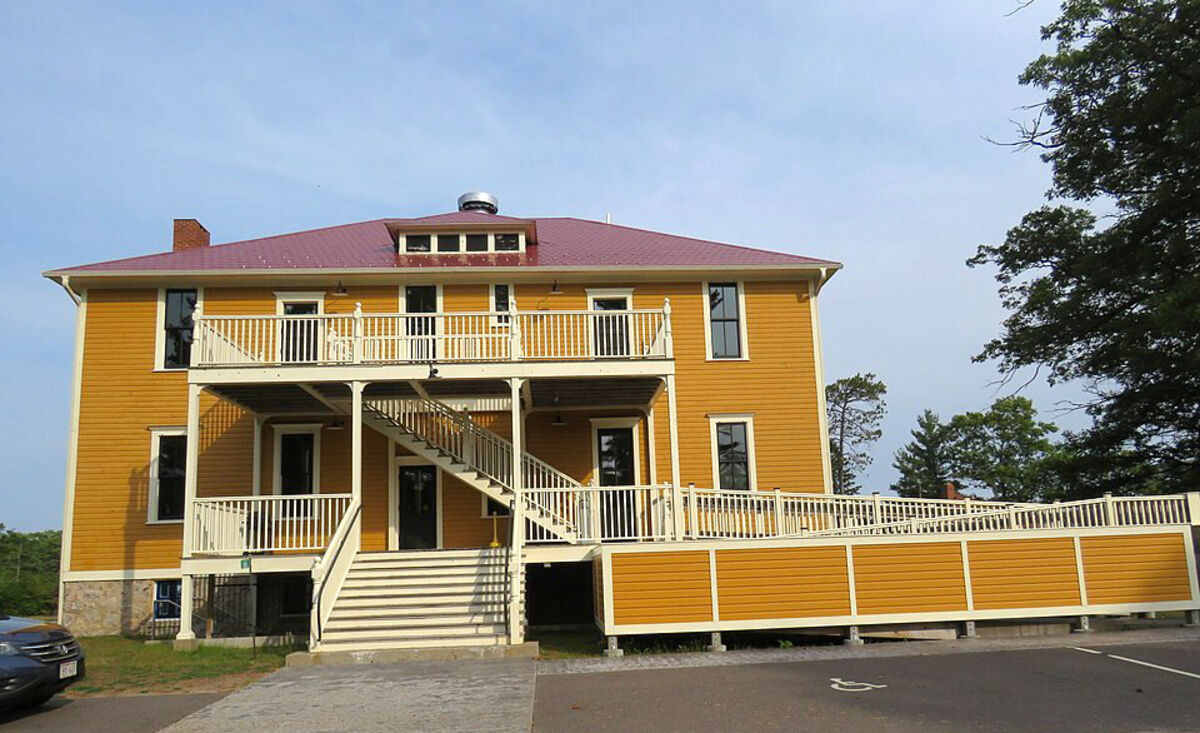
This was the boy's dorm of the Indian Boarding School in Lac du Flambeau built in 1895. Children were forcibly removed from their homes and brought here to be educated to "assimilate". It is now a museum open to the public.
TULSA, Okla.-After recording more than 380 stories from Indigenous boarding school survivors in 19 states, a national oral history project recently made its final stop in Tulsa.
In the last two centuries, the federal government sponsored 500 boarding schools, intended to assimilate tens of thousands of Native American children into white culture. The schools began around 1819 and ended around 1969, leaving many elders who still remember the dark days of being pulled from their families and enrolled in the schools.
In recent years, the National Native American Boarding School Healing Coalition (NABS) accepted a grant from the Department of the Interior (DOI) to conduct video interviews with Indian boarding school survivors across the United States. The purpose was to create a permanent oral history collection.
The Oral History Project spanned 28 months, 86 tribes and 19 states. When the National Native American Boarding School Healing Coalition (NABS) set out in 2024 to document what happened at these schools, they conducted their first interviews with survivors in Oklahoma.
The recent closing ceremony in Tulsa "closed the circle," said Lacey Kinnart, who is Sault Ste. Marie Ojibwe and codirector of the NABS Oral History Project.
"For generations, boarding school survivors were told to forget and to be quiet. Forget their language, forget their songs, forget their ceremonies, forget who they are," Kinnart said at the event. "And this project said something entirely different. We said, we remember. We believe you. Your story matters. Your life matters, and your truth will outlive every one of us long after we're gone."
Recorded interviews with 383 survivors, along with photographic portraits, will be permanently housed at the Library of Congress and are expected to be made available to the public in early 2027.
Though the ceremony marked the end of a multi-year effort, NABS will continue to aid those survivors healing from their experiences. The organization is planning another phase of the project, which will include Indigenous descendants, historians, tribal historic preservation officers and knowledge keepers.
"Children yet unborn will hear these stories. Researchers will learn from these stories. Hopefully, Congress will learn from these stories," Kinnart said at the ceremony. "Families will reconnect with pieces of themselves they never knew existed. Our descendants will know that when they needed us most, we did not look away."